命中注定我爱你
书名:老千|作者:笑无语|本书类别:古言|更新时间:13:41:01|字数:3896字
一 | Ranbir Kapoor currently has two big projects in development: Nitesh Tiwari's Ramayana and Sanjay Leela Bhansali's Love & War. Ramayana is planned as a two-part film, with releases scheduled for Diwali in 2026 and 2027. The release date for Love & War has not yet been announced. However, according to a report from Bollywood Hungama, Ranbir is reportedly wanting Bhansali's film to be released by June 2026. Reportedly, Ranbir wants to maintain a minimum four-month gap between the releases of Love & War and Ramayana. Given that Ramayana is ideally suited for a Diwali release, he has reportedly requested Sanjay Leela Bhansali to release Love & War in theatres latest by June 2026. However, a source close to the film also informed that Bhansali is interested in releasing Love & War in August, coinciding with Independence Day. The source said, “But RK feels that there’s too little of a gap between Love & War and Ramayana. He is firm on his stance of releasing Love & War in June. Ranbir’s producer, Namit Malhotra too, is putting the pressure to ensure that SLB releases Love & War in June, as he doesn’t want the aftermath of Love & War to impact Ramayana in any way, given that the latter is a much bigger film.” The source added, “The makers of Love & War starring Ranbir Kapoor, Vicky Kaushal & Alia Bhatt are eyeing a June 5, 2026 release. Slated exactly a week after the IPL finale and coinciding with summer holidays, the date offers a prime launchpad for a big-ticket spectacle like Love & War. With no immediate box-office clutter and a high footfall period, this could be a strategic move to maximise the film’s reach.” Earlier this year, during a meet and greet event in Mumbai, Ranbir Kapoor discussed the project, saying, “Love & War is something which is every actor’s dream. To work with brilliant actors like Alia and Vicky and to be directed by the master, Sanjay Leela Bhansali. I worked with him 17 years ago. To work with him again, I can say this with so much of clarity that I haven’t met a human being who works so hard, who understands characters, emotions, music, Indian culture, Indian value system, as much as Sanjay Leela Bhansali. Just to be on his set, it is tiring. It is long. The process can be a little daunting but eventually, as an artist, it is so satisfying. He really nurtures art. As actors, it’s truly been amazing so far.” Also Read: Photos: Ranbir Kapoor and Alia Bhatt’s On-set Stills From SLB’s Love and War Break The Internet。
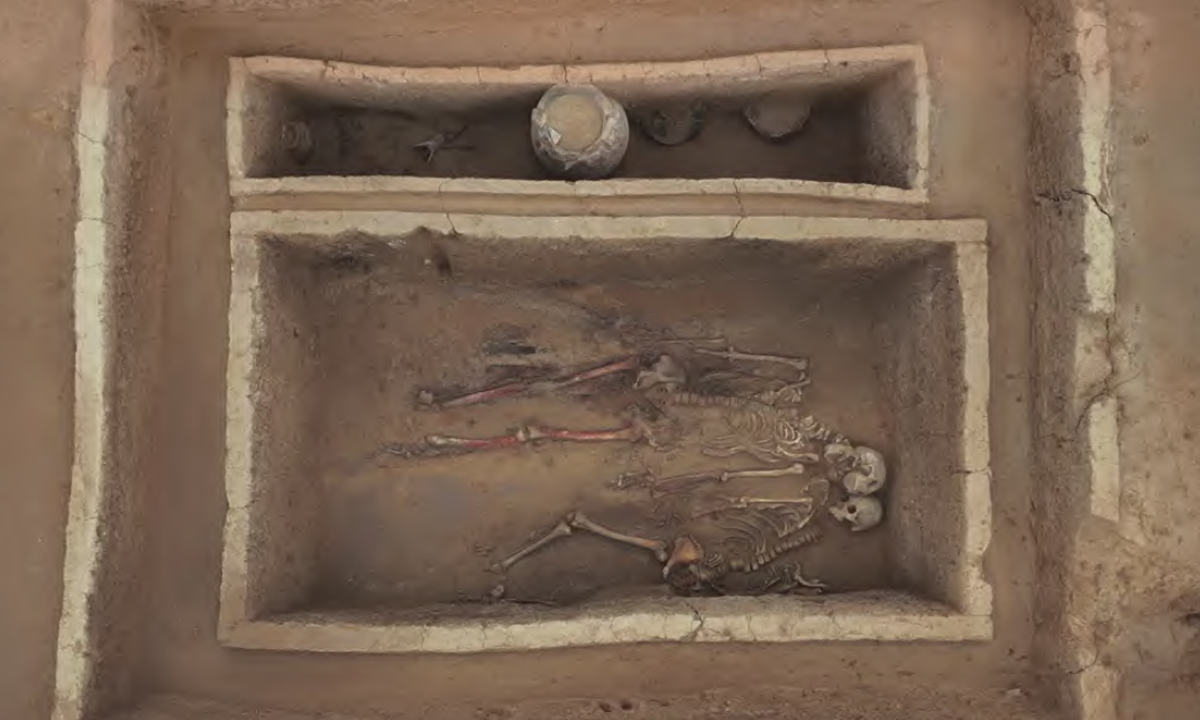
Located on a hilly terrace west of the Taihang Mountains and flanked by the Songxi River, the site was excavated in 2024 and 2025 by the Shanxi Provincial Institute of Archaeology and partner institutions, leading to the discovery of 18 tombs, including six Xia Dynasty burial sites and 12 Warring States Period (475BC-221BC) graves.
"These are the highest-ranking Xia aristocratic tombs discovered so far, indicating that this location was a regional center," the institute said.
The Xia Dynasty is traditionally regarded as China's first hereditary dynasty, though contemporaneous written records are lacking.
The well-organized Xia tombs, concentrated in the western part of the cemetery, feature uniform east-west oriented vertical earthen pits. Researchers recovered nearly 40 sets of artifacts with distinctive local cultural characteristics, including pottery, lacquerware and turquoise ornaments.
Extended regional surveys across the Songxi River valley yielded more than 10 Xia and Shang period sites. Test excavations at nearby relic sites unearthed pottery fragments, stone tools, bronze knives, as well as tin-bronze ingots and smelting residue, providing solid evidence of early metal mining and craftsmanship.
Local copper-iron symbiotic ore deposits confirm exploitation of these resources during the Xia and Shang eras, while typical cultural artifacts found in adjacent counties reveal widespread regional cultural exchange.
Multidisciplinary analyses further decoded the civilization's features. Ancient human remains belong primarily to the ancient population of the Central Plains with minor Mongolian Plateau genetic traits, forming a stable patrilineal clan. The community relied on millet farming and maintained long-distance resource trade networks.
Artifact provenance tests trace scallop shell ornaments to the Bohai Sea, cinnabar to Hunan-Guizhou ore belts, turquoise to the eastern Qinling Mountains area, and coffin timber to local Taihang pine trees. Such diverse materials reflect close interaction among the Taihang foothills, the press release noted.
Lab restoration unveiled refined ritual relics, including a dragon-patterned lacquer cylinder with red and black stripes and an intact lacquer gu vessel (a type of wine vessel). Turquoise plaques from the site match specimens from the Erlitou site, a core Xia cultural relic, proving cross-regional cultural interaction. Radiocarbon dating places the site's active period between 1880BC and 1450BC, aligning with the late Xia Dynasty.
Scholars confirmed the findings have helped reshape academic understanding of Xia-Shang civilizations and reconstruct multi-level settlement patterns on the western Taihang foothills, while offering new insights into social complexity and civilization development in early China.
。


